Progetti in evidenza
| Bando MIMIT "MISE H2-ICE: Hydrogen-fuelled internal combustion engine" |
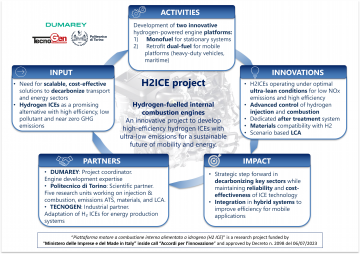
| The H2ICE project is an ambitious initiative that aims to develop two innovative hydrogen-powered engine platforms: a monofuel engine and a dual-fuel one. These engines are designed for application in both stationary systems, such as combined heat and power (CHP) units, and mobile platforms, including heavy-duty vehicles like buses, trucks, and pick-ups, as well as maritime transport. The overarching goal of the project is to offer a scalable, cost-effective, and sustainable alternative to diesel engines and more expensive zero-emission technologies like fuel cell electric vehicles (FCEVs). At the heart of the project is the development of internal combustion engines capable of running on hydrogen while achieving ultra-low pollutant emissions and extremely high thermal efficiency. The engines will be designed to operate with ultra-lean air-fuel mixtures, allowing for NOx emissions lower than 0.05 g/kWh and thermal efficiency above 42%. These figures make hydrogen ICEs a promising solution for urban transport and stationary energy generation, particularly because of their potential to integrate well with hybrid systems. In urban bus applications, for instance, hybridization allows for energy recovery during braking and a reduction in engine size, thus improving overall system efficiency and performance.
However, achieving these ambitious targets poses significant technical challenges. Managing hydrogen injection and combustion in ICEs requires advanced control strategies to avoid issues like backfire or poor mixture formation. The project addresses these challenges by developing innovative diagnostic tools for detecting knock and misfire and by identifying the optimal operational “sweet spot” in ultra-lean combustion. The H2ICE project has been coordinated by Dumarey Automotive Italia S.p.A., a company with a strong legacy in engine development and innovation, and now part of the Belgian Dumarey Automotive Group. The company has been supported by two key partners: Politecnico di Torino and TecnoGen S.p.A. Politecnico di Torino has contributed to the project through five specialized research units from the departments of Energy (DENERG) and Applied Science and Technology (DISAT), focusing on fuel injection and combustion, pollutant emissions aftertreatment, materials compatibility, and life cycle assessment. TecnoGen, an internationally recognized manufacturer of generator sets and CHP units, will lead the adaptation of the hydrogen ICE into energy production systems, leveraging its patented FUSTEQ technology to deliver low-noise, energy-efficient solutions. With a planned duration of 36 months, the project has been funded through Italy’s “Accordi per l’Innovazione” program (PNRR M4C2‑12.2bis) under the Ministry of Enterprises and Made in Italy (Prog. n. F/310304/01-03/X5). Ultimately, the H2ICE project represents a strategic step forward in the transition toward low-emission mobility and power generation. By combining advanced engineering with applied research, it offers a promising route to decarbonize key sectors of transport and energy while maintaining the reliability and the cost-effectivness of internal combustion engines technology. Il progetto è "finanziato dall'Unione europea - NextGenerationEU"
|

| Progetto EU Interreg Central Europe "PROSPECT2030 - PROmoting regional Sustainable Policies on Energy and Climate change mitigation Towards 2030" |
| Il progetto si concentra sulle buone pratiche di governo e di indirizzo come azioni fondamentali per ridurre le emissioni di CO2, capaci di guidare la transizione energetica verso un’economia decarbonizzata. PROSPECT2030, attraverso il dialogo con le amministrazioni pubbliche regionali e i principali stakeholder, intende aumentare la consapevolezza dell'urgente necessità di adottare azioni di mitigazione del clima coinvolgendo le autorità pubbliche regionali dell'Europa centrale. Una diagnosi della situazione energetica attuale, con uno sguardo critico a ciò che è stato fatto nel periodo 2014-2020, sarà il punto di partenza per innescare politiche che aumentano l'utilizzo efficiente dei fondi pubblici pianificati oltre il 2020, verso lo sviluppo di regioni sostenibili e un corretto utilizzo delle fonti energetiche rinnovabili territoriali (FER). Maggiori informazioni al link: https://www.interreg-central.eu/Content.Node/PROSPECT2030.html |
| Progetto i-link+ 2019: LINKA20220 - Nanotechnology-based thermochromic (nanoTC) materials for adaptive building envelopes [2020-2021] |
| The proposed internationalization network aims to be the seed for a wider multidisciplinary and multinational consortium for development of nanotechnology-based thermochromic (nanoTC) materials for adaptive building envelopes as a smart approach to improve energy efficiency of buildings and reduce environmental impact of urban areas. Regarding this development, the present network has two objectives:
Development of nanoTC building materials will optimize the use of solar energy to mitigate economic, social and health problems related to energetic and environmental impact of urban areas. Particularly Politecnico di Torino will focus on the performance of transparent TC materials at improving whole buidling energy use and indoor environmental quality, and their integration into the transparent part of the building envelope. For further info about the consortium and the project, please contact fabio.favoino@polito.it or valentina.serra@polito.it |
| Progetto cofinanziato da Erasmus+ Programme of the European Union DENSYS - Decentralised smart ENergy SYStems |
|
Erasmus Mundus Joint Master Degree DENSYS is a collaborative two-year (120 ECTs) joint master degree programme with the goal to provide training in the inter-disciplinary fields of Decentralised smart ENergy SYStems. These systems play an increasing role in the perspective of a massive integration of the renewable energy sources into the energy system and the ongoing transition towards a low carbon society. Co-funded by the Erasmus+ Programme of the European Union, DENSYS will have its first edition in 2020/2021 as an Erasmus Mundus Masters programme, not only an exchange programme but a programme which provides scholarships for studies in leading European Universities with distinctive and complementary academic qualities and strong educational and research traditions such as Université de Lorraine (Nancy, France), Politecnico di Torino (Torino, Italy), Royal Institute of Technology (Stockholm, Sweden), Universitat Politecnica de Catalunya (Barcellona, Spain). Decentralised smart energy systems (e.g. isolated villages, small cities, urban districts, rural areas connected or not to the electric grid, etc.) play an increasing role in the perspective of a transition towards a low carbon society and then of a massive integration of renewable energy sources within the global energy system. Accordingly, the overall goals of the proposed EMJMD “DENSYS” are the following:
|
| InnoEnergy - Master in Energy Storage |
|
The Master in Energy Storage is a next-generation learning journey that provides you with the tools to face new challenges and to launch a world-class career at the forefront of energy storage, a rapidly evolving theme. Today batteries and storage systems are of great importance to ensure the planned energy transition to Europe. The second year master's degree at the Polytechnic of Turin focuses mainly, but not only, on automotive applications. Delivered by InnoEnergy, global pioneers in sustainable energy education, the Master in Energy Storage leverages a unique global network and unmatched expertise. This is a research-oriented Master of Science jointly realized by three top-level European institutions, in the framework of the KIC InnoEnergy:
Additional information is available on the official E-STORE website, while for the student plan have a look at Polito Student Program |